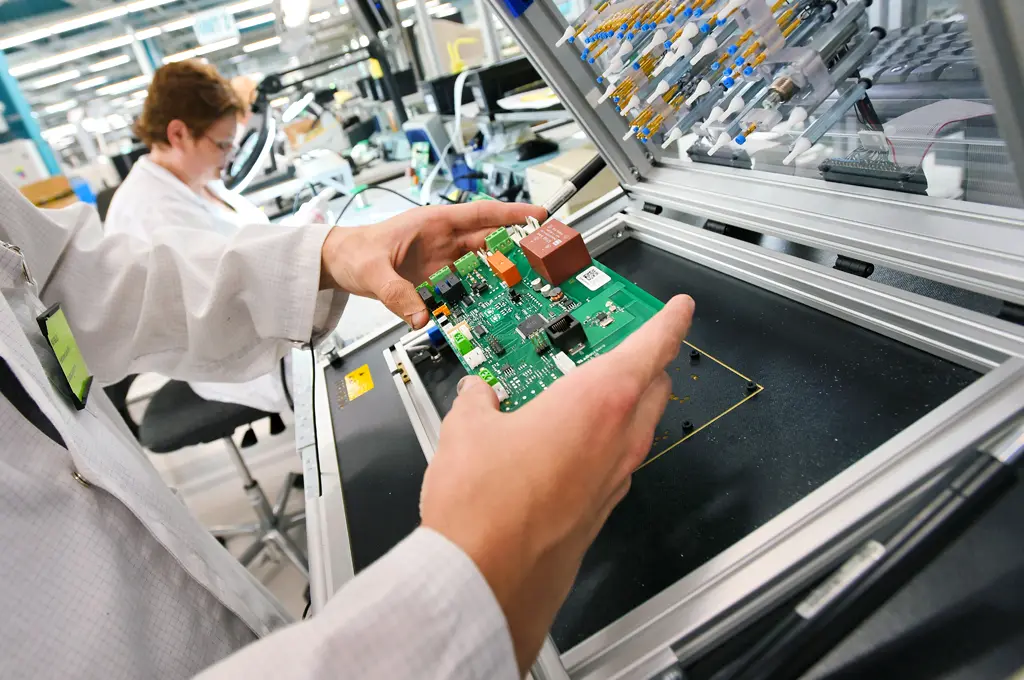
FCT is a functional circuit tester, an automated device used to test whether a completed electronic circuit board operates according to the design specifications. This device operates after the assembly process, evaluates the product quality and verifies the functional blocks, operating parameters, and inputs/outputs of the circuit board.
Main functions of FCT machine
Comprehensive functional testing: Not only testing each individual component (like ICT machines), FCT machines will test the overall operation of the entire circuit board, simulating the actual functions of the final product (like TVs, phones, washing machines).
Quality assessment: The machine gives the results of product quality assessment after completion, ensuring that the product meets technical standards.
Error detected: Early detection of functional errors helps reduce repair costs and improve production efficiency.
Integration with other devices: Operates on test software, communicating with external programming devices such as computer monitors, multimeters, and communication ports.
FCT machine is consulted, designed and manufactured by Semiki; used to test the function of electronic circuit board components of electric vehicle screens, printer circuit boards, robot vacuum cleaner circuit boards...
FCT testing is performed by simulating the product's actual operating environment and testing functional parameters such as voltage, current, frequency, as well as communication and input/output functions. This helps detect manufacturing or design flaws before the product undergoes final assembly or delivery to the customer, thereby ensuring product quality and reliability.
FCT (Functional Circuit Tester) is made up of many components that work together, including hardware and software, to perform the electronic circuit function testing process automatically and accurately. The main components include:
Control Computer (PC) and Software: This is the brain of the FCT system.
PC provides user interface and processing power.
Testing software (test software) contains scripts and pass/fail criteria, controls the entire testing process, reads data, analyzes results and stores reports.
Semiki's testing software integrates with various other testing applications on FCT machines.
Test Fixture / Jig FCT: This is the physical interface that connects the FCT machine to the printed circuit board (PCBA) being tested.
It is specifically designed for each type of board, ensuring precise contact points.
Inside usually contains the Battery pin (Test Probe/Pin ICT/FCT) spring-loaded to provide consistent contact pressure to the measuring points on the PCBA.
Semiki designed the test fixture with test probe pins from a major manufacturer.
Instrumentation and power supply devices: These devices are integrated into the system to generate excitation signals and measure responses from the board.
DC/AC power supply: It provides the necessary power supply for the circuit board to operate.
Digital Multi-Function Meter (DMM): Measure voltage, current, resistance, frequency, etc.
Signal Generator: Provide input signals as required.
FCT system manufactured and distributed by Semiki is used for testing on refrigerator circuit boards.
Control and communication systems:
Controller: Usually a PLC (Programmable Logic Controller) or microcontroller, to control actuators such as pneumatic cylinders (for pneumatic jigs), switching relays, indicator lights, etc.
Communication Interface: Allows the computer to communicate with measuring devices and boards (e.g. via USB, Ethernet, RS-232, JTAG, etc.).
Semiki's FCT system integrates optional functions such as automatic chip programming and chip error checking.
Using FCT (Functional Circuit Tester) to test the circuit board is the step mandatory and essential in mass production of electronics because it offers many important benefits in quality, production efficiency and cost.
1. Ensure product quality and reliability
The core purpose of FCT is to verify that the board functions as designed. It simulates real-world operating conditions (e.g., powering, sending input signals, checking communication) to ensure that all functions operate correctly. This directly determines the reliability of the final product when it reaches the user.
2. Early detection and elimination of manufacturing defects
During the assembly of a printed circuit board (PCBA), various types of errors can occur, such as:
Incorrect component installation: Using the wrong resistor or capacitor values.
Welding error: Short circuit, open circuit, cold welding.
Component error: The component was defective from the start.
FCT can detect these defects at the factory. Without FCT, these defective boards would be packaged and shipped, resulting in a high defect rate.
3. Minimize repair and warranty costs.
“The earlier the error is detected, the lower the repair cost” is the golden rule in manufacturing.
On-board debugging at the production line is very low cost.
If the defect is discovered after the product has been fully assembled, the repair cost will be higher (the product will have to be disassembled).
If the error is discovered by the customer (warranty, return), the cost will increase a lot (transportation, repair, labor, and damage to brand reputation). FCT helps prevent these costly expenses.
4. Improve production efficiency
By quickly determining whether a board passes (PASS) or fails (FAIL), the FCT enables efficient sorting and processing of boards:
The qualified board can move on to the next stage immediately.
Faulty circuit boards are sent to the repair station for repair. This process helps maintain a stable production throughput.
5. Compliance with quality standards
Many industries, especially medical, automotive, and aerospace, have very strict quality standards. FCT is a mandatory requirement to demonstrate that a product meets the established safety and performance standards.
6. Provide data for process improvement.
FCT software typically stores data from each test. This data (e.g., which errors occur most frequently) is important to quality and manufacturing engineers. They can analyze the data to find the root cause of errors and improve the manufacturing process (e.g., adjust the wave soldering machine, retrain workers), thereby reducing the overall error rate.
SEMIKI is one of the prominent companies in the Vietnamese market, specializing in providing industrial measuring solutions and equipment. They are known as a solution provider, direct manufacturer of FCT machines and a representative for distributing and integrating solutions from other brands.
SEMIKI's role in the FCT field
Consulting and solution integration: SEMIKI not only sells equipment but also consults, designs and integrates customized functional test (FCT) systems to suit the specific requirements of each customer in the electronics industry.
Supplying measurement and control equipment: They provide core components for building FCT machines, including testing software, FCT measurement data storage, test fixtures (FCT/ICT), sensors, and precision measuring devices from world-leading brands.
Technical support and maintenance: With a team of engineers in Vietnam, SEMIKI provides technical support, installation, calibration and maintenance services for the production lines and inspection systems they supply.
When contacting SEMIKI to provide any other FCT machine solution, careful preparation of information will help the consultation process to be faster, more accurate and more effective. You need to prepare the following information and technical documents:
1. Information about the PCBA to be tested
This is the most important part, helping SEMIKI understand your technical requirements:
Design drawings (Gerber files) and bill of materials (BOM – Bill of Materials): Provide these documents so they understand the circuit layout, component placement, and test points.
Golden Sample PCBA: A few working prototype boards are essential for Semiki to study Jigs/Fixture design and determine measurement points.
Specific functional requirements: Clearly list the board functions that need to be tested. For example:
What ports does the board communicate with other devices via (USB, Ethernet, RS-232)?
At which points should the voltage and current be checked?
Do I need to check the LED brightness, sound, or sensors?
Schematic Diagram: Helps SEMIKI engineers gain a deeper understanding of signal flow and how circuits work.
2. Production parameters and quality requirements
This information helps determine the capacity and level of automation required for the FCT machine:
Expected output: How many boards need to be tested per hour/day/month? This affects the test speed and machine design.
Level of automation: Do you need a manual (worker-operated) FCT machine, a semi-automatic machine, or one fully integrated into an automated (in-line) production line?
Reporting and Traceability Requirements: Do you need the FCT to store test data of each board (e.g. serial number, date and time, PASS/FAIL results) for quality management purposes?
Quality standards: What standards must your circuit board comply with (e.g., automotive, medical, IPC industry standards)?
3. Budget and estimated timeframe
Estimated Budget: Providing a projected budget will help SEMIKI propose the most suitable solution, balancing cost and performance.
Implementation timeline: When do you need the FCT machine ready?
Preparing the above information well will help SEMIKI quickly grasp your requirements, provide the most accurate quotation and technical solutions, significantly shortening the time from the beginning of consultation to the complete installation of the FCT machine.
 English
  Vietnamese
  Japanese
  Korean