 English
  Vietnamese
  Japanese
  Korean


Gloss is determined by shining a beam of light of fixed intensity and angle onto the surface and measuring the amount of light reflected at equal but opposite angles.
There are several different geometries available for gloss measurement, each depending on the type of surface being measured. For non-metallic materials such as coatings and plastics, the amount of reflected light increases with increasing angles of illumination, as some of the light passes through the surface material and is either absorbed into the surface or diffusely scattered from the surface depending on the surface colour. Metals have much higher reflectance and are therefore less dependent on angle.
Product line Gloss Checker SEMIKI's Gloss Checker provides an easy-to-use and objective way to check surface gloss, eliminating the ambiguity of subjective observations. SEMIKI's Gloss Checker product line provides a numerical value for gloss, which can be used in quality control and process benchmarking.

When light strikes an object, some of it is reflected, refracted, or absorbed. There are basically two ways light reflects off a surface, specular reflection and diffuse reflection. The Horiba gloss tester measures specular reflection. The angle of incidence can be set at two different angles, 20° and 60° (IG-331) to suit different surface conditions. The standard incident angle set for most applications is 60°.

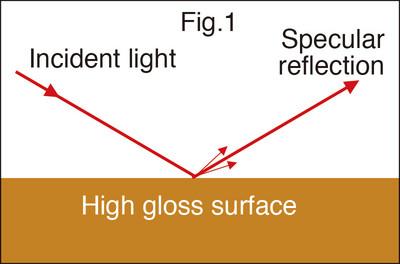
Specular reflection is a mirror-like reflection in which the angle of incidence is identical to the angle of reflection with respect to the surface normal. . Polished surfaces produce more specular reflection and less diffuse reflection.
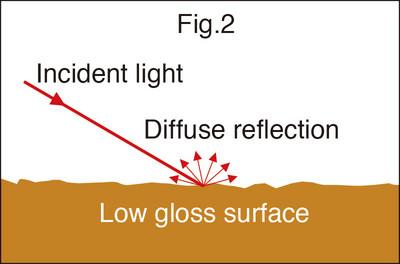
Diffuse reflection is a fuzzy reflection in which incident light is reflected at many different scattering angles. A frosted glass or cardboard produces less specular reflection and more diffuse reflection. We perceive such a surface as dull or matte.
HORIBA gloss testers offer instant and highly accurate measurement, and can be applied in many places such as polishing, painting, building cleaning and visual inspection of furniture and building materials.

Gloss measurement is based on the amount of light reflected off a surface compared to a polished standard glass, measured in Gloss Units (GU). The amount of light reflected off a surface depends on the angle of incidence and the nature of the surface.
Gloss is classified as matte, semi-gloss, or high gloss. To determine the best measurement angle, start with the gloss meter set at a 60° angle of incidence.

If the result is between 10 – 70GU, the coating is considered ‘semi-gloss’ and must be measured at a 60° angle on a gloss meter. If the result is less than 10GU, the product is considered “low gloss” and must be measured at an 85° angle on a gloss meter, and if the result is greater than 70GU, the product is considered “high gloss” and must be measured at a 20° angle on a gloss meter.
All three angles should be recorded (20, 60 and 85°) when measuring gloss on anodized metal to ensure a clear understanding of the specular reflectance between the coating and the metal substrate.
| Gloss range | 60° value | Measured by |
| High gloss | > 70GU | 20° |
| Sell ball | 10 – 70GU | 60° |
| Low/Dim | < 10GU | 85° |


Although the Gloss Unit (GU) scale is linear, each angle of incidence has a different measurement range; 0 – 2000GU (20°), 0 – 1000GU (60°), 0 – 160GU (85°).
% Reflectance compares the amount of light energy transmitted and received by the gloss meter and expresses the value as a percentage of the full incident angle measurement range and the value is displayed as a percentage relative to the selected incident angle.
Vì phạm vi đo của máy đo độ bóng 20° là 0 -2000GU; giá trị 1000GU ở 20° sẽ được biểu thị là 50%20 và giá trị 500GU sẽ được biểu thị là 25%20. Giá trị 500GU ở 60°, nhưng sẽ được biểu thị là 50%60 vì phạm vi đo cho 60° là 0 – 1000GU. Bề mặt càng sáng bóng thì giá trị sẽ càng gần 100%.
Materials with high refractive indices such as clear plastics or varnishes can have values above 100GU. Highly reflective metals can have gloss values up to 2000GU. Furthermore, the measurement value can increase for transparent materials due to the large amount of reflection in the bulk of the material. In all these cases, it is common to express the measurement result as % Reflectance.
Car wash, polish, paint
Building cleaning and maintenance
Cleaning solar panels
Check the appearance of the furniture
Visual inspection of construction materials
Check the finishing of the stone polishing
Confirm cleaning performance
Check the appearance of printed documents
Check the appearance of the plastic
Please contact SEMIKI to have the most suitable product gloss measurement solutions from Japan.
CONTACT:
SEMIKI Measuring Equipment Company Limited
Email: [email protected]
Phone: +84 9797 61016


