The identification product gloss ( gloss check It plays a crucial role in industrial quality and aesthetics management, helping to eliminate subjective assessments and provide accurate quantitative indicators.
The importance of determining gloss
Ensure consistency: Controlling gloss helps ensure that production batches have a consistent appearance, avoiding visual discrepancies that could negatively impact consumer perception.
Surface quality index: A decrease in gloss is often a sign of problems such as: paint not drying completely, low paint viscosity, or insufficient coating.
Protection features: High-gloss surfaces are generally easier to clean, less prone to dirt buildup, and offer better corrosion resistance (especially metals).
Commercial value: In industries such as automotive, furniture, and printing, high gloss is often associated with a sense of luxury and high product value.
Working principle
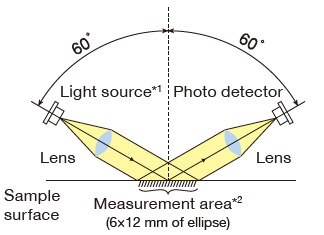
The core principle of a gloss meter is measuring specular reflection.
Illumination: The device emits a parallel beam of light from an LED light source (with a fixed intensity) onto the material surface at a defined angle (20° or 60°).
Reflex: Light is reflected back from a surface at an angle equal to but opposite to the angle of incidence.
Sensors: A detector located on the opposite side will measure the intensity of this reflected beam.
Calculate: Glossiness is defined as the ratio of the intensity of light reflected from the sample surface to the intensity of light reflected from another surface. black glass standard plate (with a standard refractive index of 1.567).
Gloss meter Horiba IG-331 and Horiba IG-340 These are all precision measuring devices from Japan, serving the needs of surface quality control in industry..
Common applications: Both models are widely used in a variety of manufacturing industries.
Automotive & Machinery Industry: Inspect the paintwork, wax coatings, and monitor for degradation of the protective layers on the vehicle body.
Building Materials & Interior Design: Inspect the uniformity of the surface of natural stone (granite, marble), wood, concrete, ceramic tiles, and aluminum frames.
Building maintenance: Evaluating the effectiveness of floor cleaning, stone floor polishing, and waxing.
Manufacture of plastics, leather, and rubber: Quality control of plastic films, gloss of tires and leather products.
Agriculture: One specific application is measuring the glossiness of plant leaves to assess the natural wax content and quality of the crop.
Which model should I choose?
Select Horiba IG-331 when you need to measure surfaces extremely high gloss (Using a 20° angle will be more accurate than the usual 60° angle) or you need to insert the probe into the narrow, hidden location thanks to its detachable probe design.
Select IG-340 for needs rapid on-site measurementIt can be used to check the flatness of floors or building materials. The device has major advantages in terms of data storage capacity, USB connectivity, and environmental resistance (IP42).
How to measure gloss (Standard procedure)
To obtain accurate results, the measurement process typically includes four main steps:
Surface cleaning:
Ensure the surface to be measured is clean of dust, grease, and fingerprints.
Clean the calibration plate that comes with the device using a soft, specialized cloth.
Calibration:
Mount the instrument onto the calibration base (which contains the calibration plate).
Press the key CAL (or the one-touch calibration button on the Horiba) to allow the instrument to automatically set the calibration value (usually 90-100 GU depending on the model).
Perform the measurement:
Choose the measurement angle: With IG-331Choose a 60° angle for medium gloss or 20° for extremely high gloss (>70 GU). IG-340The default measuring angle is 60°.
Position the machine flat and snug against the material surface.
Press the measurement button and read the result on the screen.
Data processing:
You should take measurements at least 3-5 different locations on the surface to get the correct reading. average value (AVG)This helps eliminate errors caused by uneven surfaces.
Save results to the device's memory or export data via USB port (for the IG-340 series).
Note regarding the choice of measurement angle:
Matte/textured surface: Measurements should be taken at a large angle (e.g., 85°, although the most common Horiba IG-331/340 measures at 60°).
Medium surface area (10-70 GU): Use the angle 60° (Universal angle measuring device).
Very glossy surface (>70 GU): Use the angle 20° to increase the resolution and accuracy of the measurement.
Comparison table of Horiba IG-331 and IG-340 specifications:
The main unit integrates the measuring head (Handheld).
Display range
0 – 100 (60° angle); 0 – 100 (20° angle)
0 – 100 (Maximum display: 199)
Measured area
3 x 6 mm (60°) / 3 x 4 mm (20°)
6 x 12 mm (Oval shape)
Resolution
0.1 GU
0.1 GU
Repeatability
±5% FS
±5% FS
Data memory
Simple average calculation
Save 100 individual data points / 200 average data points
PC connection
Not supported
USB port (Export report data)
Protection standards
Basic
IP42 (Resistant to dust and light splashes of water)
Electricity supply
9V battery (6F22)
2 AA (Alkaline) batteries
Size
Body: 75x140x31mm / Head: 30x28x102mm
61 x 62 x 176 mm
You can contact us. Semiki Measurement Equipment Co., Ltd. (SEMIKI) For assistance in consulting and purchasing suitable gloss meters to meet your specific testing needs, SEMIKI is a reputable distributor and supplier of measurement solutions, specializing in gloss meters from various manufacturers. HORIBA(Japan) in Vietnam.
Contact Semiki:
Website: You can find out more details and send a consultation request via Semiki.com.
 English
  Vietnamese
  Japanese
  Korean