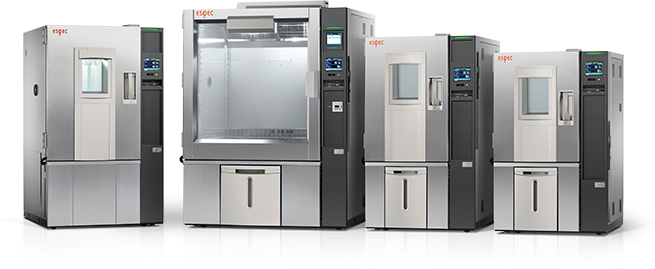
Temperature and humidity simulator cabinetTemperature & Humidity Chamber (also known as an environmental test chamber) is used to Recreate and precisely control real-world environmental conditions. (Temperature and humidity) in a laboratory environment. The purpose is to test the performance, durability, and reliability of the product under various harsh conditions before it is released to the market.
ESPEC Platinous J Series – Your best choice to cover broad reliability test applications. It offers flexible configurations to meet the needs of today and tomorrow.
Environmental test chambers simulate a range of different environments, from normal to extreme temperatures and humidity, in order to:
Product reliability testing: Assess whether the product operates reliably and maintains its quality throughout its lifespan.
Simulating real-world conditions: Recreate the environments the product might encounter, such as the extreme cold of winter, the intense heat inside a car engine compartment, or the high humidity of a tropical environment.
Accelerated Testing: Using extreme conditions beyond normal operating ranges to quickly identify weaknesses, design flaws, or material limitations.
Research and development: Assisting engineers in improving designs and selecting better materials based on test results.
Standard compliance check: Ensure that products meet industry standards and regulations (e.g., aerospace, automotive, electronics, medical) regarding quality and safety.
Espec chamber Platinous J Series PL-1J ( -40° C ~ +100° C/20% ~98%rh/ Capacity 120L)
Why use a temperature and humidity simulator to test products?
The use of temperature and humidity simulators is essential for the following reasons:
Precise control and repeatability: The natural environment is highly unpredictable. Test chambers allow for precise control of temperature and humidity parameters, ensuring consistent and repeatable test results for different product batches or after design modifications.
Early detection of vulnerabilities: By accelerating the aging process and simulating harsh environmental conditions, manufacturers can identify flaws (e.g., cracking, corrosion, electronic component failures due to moisture condensation) at an early stage in product development.
Avoid costly consequences: Releasing unreliable products can lead to customer dissatisfaction, costly recall campaigns, and damage to brand reputation. Environmental testing helps prevent these risks.
Save time and money: Instead of waiting years to see how a product performs in real-world conditions, accelerated testing in an ESPEC chamber yields rapid results, reducing time to market.
Safety Guarantee: For critical industries such as electric vehicle batteries or aircraft components, durability testing under extreme conditions is mandatory to ensure absolute user safety.
ESPEC Benchtop Temperature and humidity Chamber SH-642 (-60° C to +150° C/30% to 95%rh/64 Liters)
In addition, we will use Fine wick ESPEC is a type Specialized moisturizing paper (or cloth wick) It is used in ESPEC temperature and humidity test chambers. Its main function is to measuring and controlling humidity inside the cabinet precisely.
Specifically, fine wicks are used in wet-bulb/dry-bulb humidity measurement systems:
A temperature sensor (dry bulb) measures the actual air temperature inside the cabinet.
A second temperature sensor (wet bulb) is wrapped in this fine wick. The tail of the wick is immersed in a small reservoir of water.
Water from the reservoir will seep up the wick and evaporate. This evaporation causes the wet bulb to cool down compared to the dry bulb.
The temperature difference between the two chambers is calculated by the cabinet's controller to determine the precise relative humidity inside the test chamber.
ESPEC fine wick FW-5(WG-105) moisture test paper for ESPEC chamber
Many industries have strict international standards and legal regulations regarding product durability and safety (e.g., IEC, ASTM, MIL-STD standards for electronics, automotive, and aerospace).
Using a test chamber is a way to verify that a product meets these standards, allowing it to be certified and legally sold on the market.
Environmental test chambers are not just testing tools; they are strategic investments that help mitigate risks, ensure quality, enhance customer satisfaction, and protect the manufacturer's brand in industries such as electronics (testing circuit board durability, consumer products), garments (testing color fastness, fabric durability), and plastics (testing the durability of end products).
Key factors to consider before making a decision:
1. Temperature and Humidity Range (Performance Range)
This is the most important parameter, determining the operational capability of the test chamber.
Temperature Range: What are the minimum and maximum temperatures your test chamber needs to be able to reach?
For example: From -40°C to +150°C, or just from 0°C to +100°C (depending on your product testing standard).
Humidity Range: What humidity range should the test chamber maintain?
For example: From 20% RH to 98% RH at specific temperature levels.
Heating/Cooling Rate (Ramp Rate): Do you need a rapid temperature change (e.g., thermal shock testing)? This rate is typically measured in °C/minute.
2. Test chamber size/capacity
The size must be appropriate for the product you intend to test.
Internal Dimensions: Ensure there is enough space to place the sample (product) while still leaving sufficient room for air circulation around the sample.
External Dimensions: Check that the test chamber fits your laboratory space, including the door and ceiling.
Sample Load: What is the total weight of the products placed inside the chamber? This affects the cooling/heating performance.
3. Power supply and infrastructure requirements
Environmental test chambers are high-capacity devices that require suitable infrastructure:
Power supply: Does the room use single-phase or three-phase electricity? What is the voltage (220V, 380V, etc.)? What is the frequency (50Hz or 60Hz)?
Water system (for humidity): A continuous supply of clean water (usually distilled water or DI water) must be ensured.
Cooling system (if applicable): Some larger chambers use water cooling instead of air cooling, requiring connection to an industrial chiller system.
Ventilation: Ensure there is sufficient ventilation around the device for the cooling system to function effectively.
4. Control features and software
Programmability and monitoring capabilities are crucial for operational convenience:
Controller: Touchscreen or buttons? Is the interface intuitive?
Programming skills: Is it possible to create complex test cycles (e.g., 10 cycles of increasing temperature, maintaining humidity for 2 hours, then lowering the temperature to below zero)?
Connectivity and software: Does it have connectivity ports (USB, Ethernet, RS-232) for data output to a computer or remote control? Is the accompanying software easy to use?
5. Accessories and Additional Options
Depending on the specific testing requirements:
Cable ports: Do I need a hole to connect the internal product to the external measuring device with a cable? What are the dimensions of the hole?
Observation windows and lighting: Is it necessary to directly monitor the sample during the testing process?
Safety system: Overheating warning, phase loss protection, smoke sensor…
Sample holder: The number and load-bearing capacity of the shelves/racks.
Clearly defining these parameters will help you and your supplier (such as Semiki) select the ESPEC environmental test chamber model that best suits your technical requirements and budget.
ESPEC STPH-202 High Temperature Test Chamber (+20°C ~ +500°C/ 216L)
Friend It is entirely possible to contact Semiki company. For consultation and purchase of environmental test chambers, contact Semiki, an official distributor and partner of ESPEC in the Vietnamese market. They specialize in providing industrial testing and measurement solutions, including temperature and humidity test chambers.
Semiki's team will have the expertise to advise on the most suitable test chamber for your specific product testing needs (e.g., sample size, required temperature/humidity range, standards to be complied with). Business email:[email protected]
Phone number (Hotline): +84 979 761 016.
Website: You can find out more details and send a consultation request via Semiki.com.
 English
  Vietnamese
  Japanese
  Korean